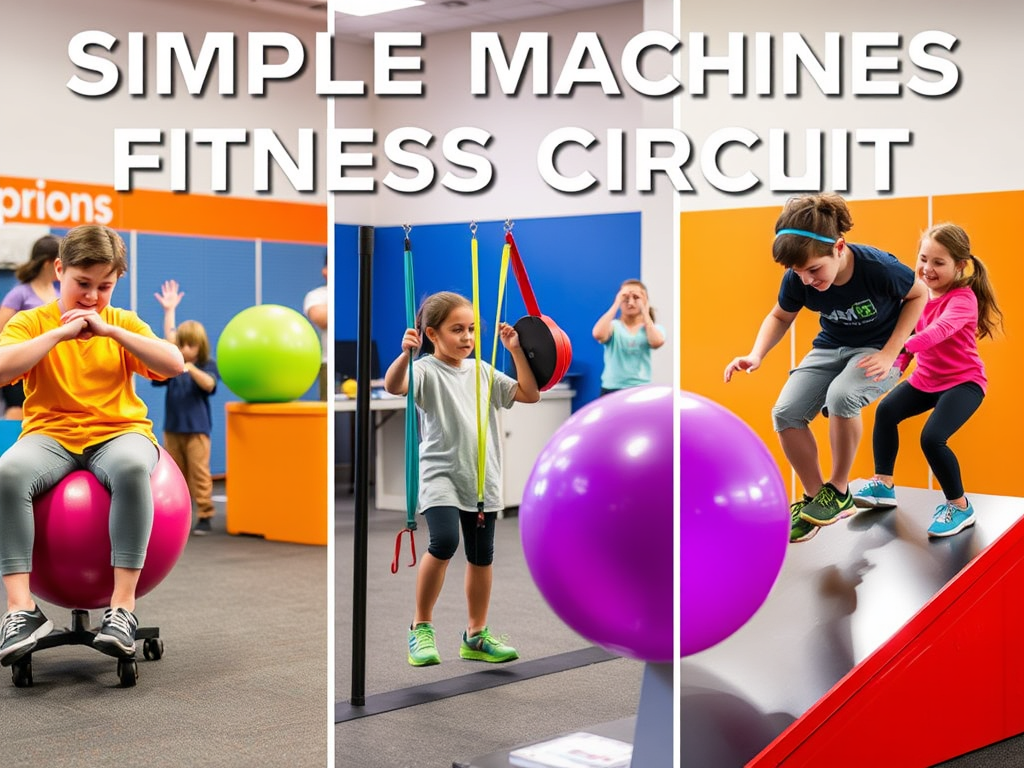
Objective: The objective of this circuit is to introduce middle school students to the principles of mechanical advantage through engaging activities that involve simple machines – the lever, pulley, and inclined plane.
Materials Needed:
- Cones or markers
- Exercise balls
- Jump ropes
- Resistance bands
- Mats or yoga mats
- Stopwatch or timer
- Whistle
Setup:
- Set up stations in an open area, using cones or markers to define each station.
- Label each station with the type of simple machine it represents (Lever, Pulley, Inclined Plane).
- Place signs or posters with brief explanations of each simple machine and its mechanical advantage.
Fitness Circuit Stations:
1. Lever Lifters
Objective: Demonstrate how levers work, focusing on the mechanical advantage they provide in reducing effort.
Setup:
- Position an exercise ball against a wall.
- Students will perform wall sits with the ball placed between their back and the wall.
Activity:
- Students lean against the ball and slide down into a sitting position, keeping their knees at a 90-degree angle and their back pressing against the ball.
- They maintain the position for a designated time (e.g., 20–30 seconds) or as long as they can.
- While holding the position, explain how their body forms a lever system:
- The wall acts as the fulcrum (pivot point).
- Their thighs represent the lever arm.
- The weight of their upper body is the load, and their quads provide the effort to hold the position.
Physics Principle:
- This activity highlights how levers reduce the force needed to hold the position by distributing effort over the fulcrum.
- Discuss how the placement of the fulcrum (e.g., closer to the load or effort) can change the mechanical advantage.
2. Pulley Pulls
Objective: Teach the concept of a pulley system and how it reduces the effort needed to lift or pull a load.
Setup:
- Attach resistance bands to a horizontal bar, pull-up bar, or any sturdy overhead structure. Ensure the bands are securely tied and at a safe height for students to pull downward comfortably.
Activity:
- Students stand beneath the resistance bands and pull them downward, mimicking the action of a pulley system.
- To add a dynamic challenge, they can alternate arms or use both arms simultaneously.
- Encourage them to focus on the sensation of tension and the effort required to move the bands.
Physics Principle:
- The resistance bands simulate the action of a pulley, where pulling downward represents the input force and the tension in the band represents the output force.
- Discuss how pulleys make work easier by distributing force and changing the direction of applied effort, which is why pulleys are common in construction, exercise equipment, and everyday tools.
3. Inclined Plane Planks
Objective: Demonstrate the mechanical advantage of an inclined plane in reducing the effort needed to hold or move a load.
Setup:
- Use a sturdy, non-slip ramp or create an inclined plane using a bench or riser.
- Place mats or yoga mats at the base for students to perform planks safely.
Activity:
- Students assume a plank position with their hands on the inclined plane and their feet on the mat at ground level.
- To increase intensity, they can alternate lifting one leg or perform shoulder taps while maintaining the plank.
- Explain how the inclined plane reduces the amount of force required to maintain the plank compared to doing the same exercise on a flat surface.
Physics Principle:
- The inclined plane demonstrates how spreading effort over a longer distance decreases the force needed to perform a task.
- Relate this to real-life examples, such as ramps for wheelchairs or moving heavy objects using inclined planes instead of lifting them vertically.
Procedure:
- Divide students into groups and assign each group a starting station.
- Provide a brief overview of each simple machine and its mechanical advantage at the corresponding stations.
- Start the circuit, having groups rotate through each station in order.
- Students perform the designated exercise at each station for a set time (e.g., 1-2 minutes).
- Rotate groups through all the stations until each group has completed the entire circuit.
- Use a stopwatch or timer to record the total time for each group.
Discussion Questions:
- How did the Lever Lifters station represent the mechanical advantage of a lever?
- What was the mechanical advantage demonstrated at the Pulley Pulls station?
- How did the Inclined Plane Planks station showcase the mechanical advantage of an inclined plane?
- Can you think of other examples of simple machines in everyday life that provide mechanical advantage?
Debrief: Conclude the fitness circuit with a debriefing session to discuss the concept of mechanical advantage. Relate the principles learned to real-world applications and the importance of incorporating simple machines into physical activity for improved efficiency.
Leave a Reply